South Carolina Probate Form SCCA 435ES

Exempt Property Claim

This page is for educational purposes only and is not legal advice. Forms and requirements change frequently — verify the current version with your local probate court or an attorney.

Last updated: June 1, 2026
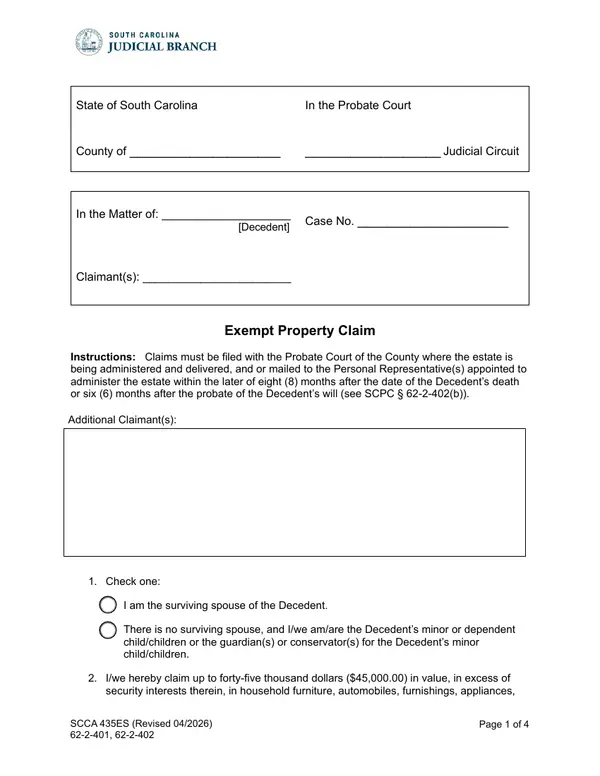
First page of Exempt Property Claim

Working through the Exempt Property Claim? SwiftProbate builds a personalized, step-by-step checklist for settling the estate — so you know which forms to file, in what order, and by when.

Get help with this form

About Exempt Property Claim

Allows a surviving spouse or minor/dependent children to claim up to $45,000 in household furniture, automobiles, and personal effects from the decedent's estate with priority over most creditor claims.

When you'd use it: File with the probate court within the later of eight months after the decedent's death or six months after probate of the will.

Where to get the official form

The official version of Exempt Property Claim is published as a PDF by the South Carolina courts. We checked this link and it resolved to a form on an official court or government website — always download the current version directly from the source rather than a third-party copy:

Verified official PDF

Download Exempt Property Claim (PDF) →

Source: sccourts.org

Link last checked: May 30, 2026

How to file Exempt Property Claim in South Carolina

  1. Step 1Confirm you have the correct formUse Exempt Property Claim (SCCA 435ES) when file with the probate court within the later of eight months after the decedent's death or six months after probate of the will. Double-check it's the right form for your situation — South Carolina probate forms are revised periodically, so verify the name and number against your court's current form list before you start.
  2. Step 2Complete every required fieldFill out Exempt Property Claim carefully and review it for errors before filing. Probate cases can already take months — a small mistake on the form can set your timeline back further.
  3. Step 3Get it notarized or witnessed if requiredSome probate forms must be signed in front of a notary or witnesses. Check the instructions on the form itself, and arrange notarization before you file if it's required.
  4. Step 4File it with the correct courtSubmit Exempt Property Claim to the probate court or county clerk handling the estate — usually in the South Carolina county where the deceased lived. Ask the clerk how they prefer to receive filings (in person, by mail, or e-filing).

Working through the Exempt Property Claim? SwiftProbate builds a personalized, step-by-step checklist for settling the estate — so you know which forms to file, in what order, and by when.

Get help with this form

Probate in South Carolina

See the full South Carolina probate guide for filing deadlines, small-estate options, timelines, costs, and county courthouse details.

Read the South Carolina probate guide →

Frequently Asked Questions

What is Exempt Property Claim (SCCA 435ES)?
Allows a surviving spouse or minor/dependent children to claim up to $45,000 in household furniture, automobiles, and personal effects from the decedent's estate with priority over most creditor claims. You'd typically use it when file with the probate court within the later of eight months after the decedent's death or six months after probate of the will.
Where do I file Exempt Property Claim in South Carolina?
Probate forms are filed with the probate court or county clerk in the South Carolina county where the deceased person lived. Our South Carolina probate guide can help you find the right courthouse, filing fees, and local requirements.
Do I need a lawyer to complete Exempt Property Claim?
Many people complete probate forms themselves, especially for smaller or uncontested estates. Complex estates may benefit from professional advice. SwiftProbate is an informational tool that helps you understand and organize the process — it is not a law firm and does not provide legal advice.
Is Exempt Property Claim available online?
Most South Carolina probate forms are published as PDFs by the state courts or the county clerk. You can find the official source linked above.

Other South Carolina Probate Forms

Need help with South Carolina probate?

  • Personalized to your assets, heirs, and jurisdiction
  • Deadlines calculated from your date of death
  • Track progress and store documents in one place
Get step-by-step help

Free — no credit card required

Informational guidance only — not legal advice

Find the other South Carolina probate forms you'll need →

Disclaimer: This page is for informational purposes only and does not constitute legal advice. Probate forms and requirements vary by state, county, and individual circumstances, and change over time. Always verify the current form and instructions with your local probate court, and consult a qualified attorney for advice specific to your situation. SwiftProbate is not a law firm and does not provide legal representation.