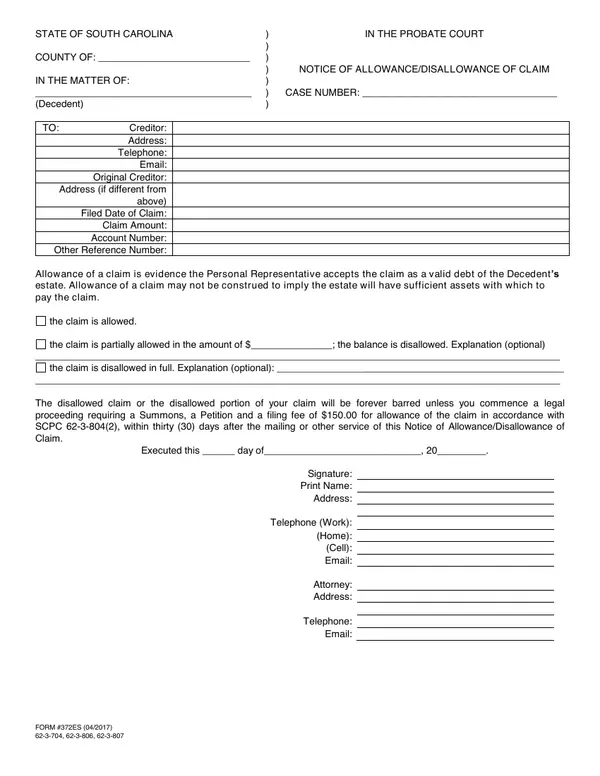
About Notice of Allowance/Disallowance of Claim
To formally notify a creditor whether their claim against a decedent's estate has been allowed, partially allowed, or disallowed by the Personal Representative.
When you'd use it: When the Personal Representative of an estate has made a determination on a creditor's claim filed against the estate and must communicate that decision within the probate process.
Where to get the official form
The official version of Notice of Allowance/Disallowance of Claim is published as a PDF by the South Carolina courts. We checked this link and it resolved to a form on an official court or government website — always download the current version directly from the source rather than a third-party copy:
Download Notice of Allowance/Disallowance of Claim (PDF) →
Source: sccourts.org
Link last checked: May 30, 2026
How to file Notice of Allowance/Disallowance of Claim in South Carolina
- Step 1 — Confirm you have the correct formUse Notice of Allowance/Disallowance of Claim (372ES) when the Personal Representative of an estate has made a determination on a creditor's claim filed against the estate and must communicate that decision within the probate process. Double-check it's the right form for your situation — South Carolina probate forms are revised periodically, so verify the name and number against your court's current form list before you start.
- Step 2 — Complete every required fieldFill out Notice of Allowance/Disallowance of Claim carefully and review it for errors before filing. Probate cases can already take months — a small mistake on the form can set your timeline back further.
- Step 3 — Get it notarized or witnessed if requiredSome probate forms must be signed in front of a notary or witnesses. Check the instructions on the form itself, and arrange notarization before you file if it's required.
- Step 4 — File it with the correct courtSubmit Notice of Allowance/Disallowance of Claim to the probate court or county clerk handling the estate — usually in the South Carolina county where the deceased lived. Ask the clerk how they prefer to receive filings (in person, by mail, or e-filing).